Showing posts with label World Bird Wednesday. Show all posts

Sunday, August 26, 2012

Baltimore & Orchard Orioles

I am linking up my Orioles with World Bird Wednesday  and Nature Notes
I posted this earlier but somehow it got out of sync. So do not worry, you have seen this post before.

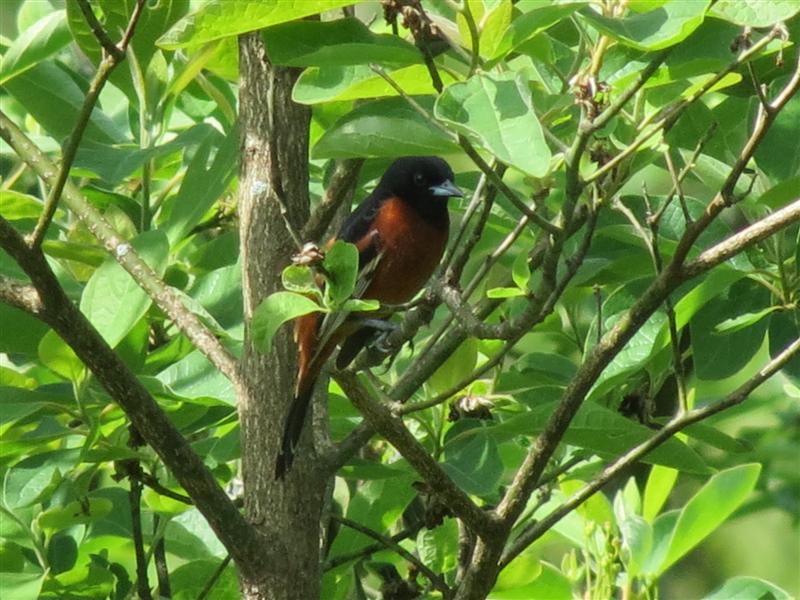
I saw these birds during an outing at the local Hashawha Nature Center. I knew from previous summers that the Baltimore Orioles were nesting in the trees at the nature center but this was the first time I saw the Orchard Orioles.


The Baltimore Oriole has a black head and back with an bright orange rump and underparts. And the wing is orange and black. The Baltimore Oriole is the state bird of Maryland. The Baltimore Oriole can be attracted to feeders with oranges or grape jelly, they also like the sugar water feeders.


The Orchard Oriole is a brick orange color on its underparts and coverts and has white in the wings.

I love both the Baltimore Oriole and the Orchard Orioles, they are gorgeous birds with pretty colors. The females look more yellowish in color.

I hope you enjoyed my Orioles and post.
To see more beautiful birds check out Springman's World Bird Wednesday  and Nature Notes.
Thanks to Springman for hosting World Bird Wednesday and thanks to Michelle the host of Nature Notes.
I also appreciate your visits and comment, have a great day and happy birding.

Tuesday, July 10, 2012

Northern Parula

I am linking up my Northern Parula with World Bird Wednesday and Nature Notes

These are some shots from last weekend, hubby and I took local walk actually a hike from our door to the peninsula tip it is around 2 1/2 miles. It was a fun birdie walk lots of chirping going on and we heard lots of youngins.


I saw this Northern Parula singing his song for me. Is that the name of a Leon Russel song? The Northern Parula is a breeding bird for my area. I can hear them from my deck, they have a cute sound with  a loud ZIP at the end. A few years ago I had a Male Northern Parula knocking on the windows on my house. It would go from the den window to my living room window, singing and trying to knock himself out. He returned for a few years and still came to the windows. I felt bad that he could hurt himself but I was thrilled to see the Northern Parula right outside my windows.


The Northern Parula is blue above and they have white lines above and below the eye. They are called arcs but they look like white eyelashes or eyeliner. The male has a yellowthroat and breast with a mottled rufous band. My photo is cropped and little fuzzy but you can make out the beautiful colors on this bird.

Even fuzzy I love this shot showing my beautiful male singing and showing off his pretty colors. I was so mad at myself I grabbed the wrong camera going out my door and my batteries died before we even started heading back home. I left my newer camera home the Canon SX40IS. Not really new, I have had it almost a year now. The zoom on it is awesome! The stabilization even at 820mm is amazing. I am just sorry I didn't have it with me for these Northern Parula shots. These pic's were taken with the older model the Canon SX20IS, which has the equivalent of a 540 lens. I am not sure how many cameras can zoom out to 840mm without needing all the extra lenses, I have to say I could  not be happier with my Canon SX40IS.


To see more beautiful birds from around the world please visit World Bird Wednesday and to see some wonderful nature scenes visit  Nature Notes. Thanks to Springman the host of World Bird and to Michelle the host of Nature Notes. Thank you for stopping by to see my World Bird post. I hope the rest of your week is a great one, happy birding.

Tuesday, July 3, 2012

Taking the back roads

I am linking up with World Bird Wednesday  and  Nature Notes

I wish all my USA readers a safe and very HAPPY 4th of JULY!!

 The weekends seem to be flying by, just like the birds. Just a  few weeks ago hubby and I decided to take a Sunday drive on the back roads of Carroll County, Maryland.  Following the lead of many Maryland birders before me... I headed out to see my first Dickcissel.


From the backside one would think this is your usual little brown bird. The adult male has a gray crown and nape contrast with yellow washed supercilium ( I still call them yellow eyebrows). It also has a black throat stripe and a yellow breast which is actually beautiful. Of course when he turned around my camera wasn't ready for a shot. But, I did get to see the front of this beautiful Dickcissel. He was posing nicely... right were he was suppose to be, at least the last reported sighting. You should really check out Wikipedia's Dickcissel so you can see how pretty he really is.

He would repeatedly fly down to the ground I guess to catch a bug and then fly back to sign for awhile. I watch for a few minutes until a truck drove down the road behind me. So, I drove to the end of the road so I could turn around to go back to see the Dickcissel. Another bird caught my attention on another sign at the other end of the road. I thought maybe I was looking at a female Dickcissel so I took a few photos before driving back to the original Dickcissel.

I posted my bird or what I thought was my female Dickcissel on my facebook page so members of my bird club could see.. when they informed my second bird was a Grasshopper Sparrow. The Grasshopper Sparrow has a pale white central crown stripe, yellow lores, white eye ring, heavy bill and a chunky body.  Cool..lifer number two..I was happy with my sightings, my next back road bird will be a Bobolink maybe during the fall migration?

 And here is the street where they live...


 So, to my delight I got two lifers on one street. The Dickcissel and the Grasshopper Sparrow. So believe me when I say it pays to ride the back roads. You never know what you might see...Happy Birding!!!


To see more beautiful birds check out Springman's World Bird Wednesday  and for more nature scenes please visit Michelle's Nature Notes.   Thanks to Springman for hosting World Bird Wednesday  and to Michelle for hosting Nature Notes. I also thank you for stopping by to see my world birds. Happy Birding and have Happy 4th of July!!

Tuesday, June 26, 2012

The Rookery

I am linking up with World Bird Wednesday and Nature Notes

These are some shots from my visit to the local Black-Crowned Night Heron and Great Egret Rookery. It is cool that the rookery is not far from where I live. So I get a chance to go and visit and see how the herons and egrets are doing. This rookery is in the middle of a Pennsylvania neighborhood. The park has a man-made lake. People are always about.... walking the path around at the lake and fishing. The rookery has been there for years and the birds do not seem to mind all the people being around them. We did see the notice stating it was a (IBA) important bird area.

The Great Egret nest are way high up in the top of some pine trees. I could make out one of the egret chicks. A fuzzy ball of cuteness.

In the same pine trees are the Black Crowned Night Heron nest. Their chicks seemed to be making big progress and growing fast.

. The Night herons chicks were a little more hidden in the pine tree branches. You can make out their darker brown body with white spots and a little of the yellow on its bill.


I was concerned about this juvie Night Heron when I noticed its bill looks crossed. I hope it is able to eat. At least it does look healthy.


This Night heron juvie with the crossed bill was walking around on the ground and then decided he wanted to climb the tree. We were a good distance away. There were about 25 or more Canada Geese on the ground below the tree and between us and the tree with the juvie heron.


The pine trees surround the lake and there must be a night heron or egret nest in every one of the trees. Above is one of the Great Egret nest.

I hope you enjoyed my World Birds this week. To see more wonderful birds check out Springman's World Bird Wednesday  and for more nature post visit Michelle's  Nature Notes

Thanks to Springman and to Michelle our great host each week. Also, thank you for visiting my blog and post. I hope the rest of your week is great and Happy Birding.

Tuesday, June 19, 2012

Black Skimmer


I am linking up with  World Bird Wednesday and Nature Notes

My World Bird this week is the Black Skimmer.

Last week hubby and I saw quite a few Black Skimmers. We saw them both at Edwin Forsythe NWR on Thursday and at Cape May on Friday.  The Black Skimmers are Tern-like seabirds.

Above my photo captured a few of them head on but I really like the side view showing off their cool looking beaks.

At Cape May I believe they were nesting on the beach. They have roped off a part of the beach and sand dunes to protect the nesting birds. They breed in loose groups on sandy beaches. Three-seven bluish eggs are incubated by both the male and female.

At the nesting area we saw the Black Skimmers, Terns and American Oystercatchers.

I tried hard to catch two Black Skimmers flying low over the ocean at Cape May. I hope you enjoyed my post and to see more beautiful birds check out World Bird Wednesday  and for more nature scenes visit Nature Notes.

Thanks to Springman of World Bird and to Michelle the host of Nature Notes. Thanks for stopping by to see my post, hope the rest of the week is a good one. Happy Birding!

Tuesday, June 12, 2012

Scarlet Tanager

I am linking up with World Bird Wednesday  and Nature Notes


The Scarlet Tanager is my bird this week. Hubby and I hear them often above our heads while we are walking on the fireroads around our house and neighborhood. The Scarlet Tanager is a breeding bird here in Maryland and they are nesting right here at the watershed...the woods surrounding our house.

The male is a gorgeous red with black wings and tail.  They nest in deciduous and mixed woods. The female is an olive with brownish wings. The juvenile male has the coloring like the female but with black wings. Their song is one I recognize each year when they return to my woods. Definitely one of the more colorful birds I see and another one of my favorite summer birds.


To see more beautiful birds please visit World Bird Wednesday   and  Nature Notes

Thanks to Springman the host of World Bird Wednesday and thanks also to Michelle the host of Nature Notes.
Also, thank you for stopping by to see my bird and photos. I appreciate your visits and comments. Hope the rest of your week is great...Happy Birding!!

Tuesday, May 29, 2012

Black-faced Grassquit

I am linking up with World Bird Wednesday and Nature Notes

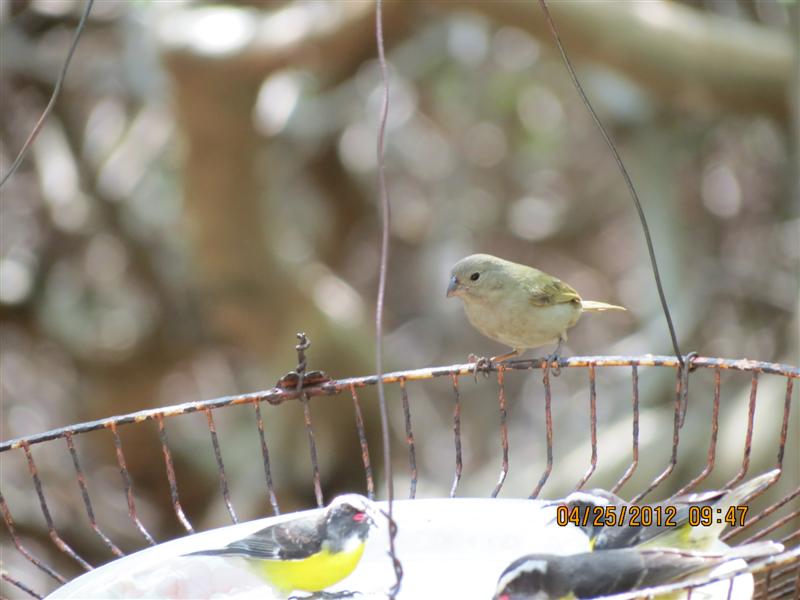
This bird is one of my latest lifers from Curacao..the Black-faced Grassquit. Weird name but a very cute bird. It is considered a Tanager and is known to breed along the coast of Venezuela. The male is olive green above and has a black head and breast. The female and the immature are dull olive-gray and paler gray underparts.


The Black-faced Grassquits feed mostly on seed of grasses and weeds. When I saw them they were chowing down at the sugar feeder.


I was happy to be able to see both the male and female. Above the female is perched on the sugar feeder with the Bananaquits. I know professional photographers prefer to take photos of the birds in more natural surroundings. But, being a birder I am into seeing a new bird where ever it maybe... even on the feeders.

I have been busy working during the week and going on weekend daytrips and family get togethers I have not updated my lifer list. I must do that soon I am really behind.

To see more beautiful birds from around the world check out Springman's World Bird Wednesday  And for some nature scenes please visit Michelle's  Nature Notes.

Thanks to Springman for hosting World Bird Wednesday and to Michelle for hosting Nature Notes. I also appreciate everyone who stops by to see my post. I wish you all a great week and happy birding.

Tuesday, May 22, 2012

Magnificent Frigatebirds

I am linking up my Magnificent Bird with World Bird Wednesday  and Nature Notes


The Magnificent Frigatebirds are a common birds seen in the Caribbean. It is fun to watch them climb high in the thermals and then descend close to the sea. They feed mainly on fish and take their meals in flight never landing in the sea.


The females are black and have a white breast and the males are all black.


The juveniles have a white head and underparts.


We saw many of these Magnificent Frigatebirds in Curacao, they were also very common in Panama.

To see more beautiful birds check out Springman's World Bird Wednesday   and Nature Notes.
Thanks to Springman for hosting World Bird Wednesday and to Michelle the host of Nature Notes.

Thanks also for stopping by to see my post, I appreciate the visits. I hope everyone has a great week.

Tuesday, May 15, 2012

World Bird...the Rufous Collared Sparrow

I am linking up with World Bird Wednesday and Nature Notes

For my World Bird this week I have another bird from Curacao. It is the Rufous Collard Sparrow. We saw this bird often around the sugar feeders and other places around the island.


The sdult has a grey head with broad black stripes on the crown and thinner stripes thru the eyes. The nape and breast sides are rufous in color, the throat is white and the underparts are off whtie . There are two white wing bars.


I like the rufous color on this sparrow, it is a very pretty bird.

This Rufous-collared Sparrow was seen under a lounge chair at the beach.


To see more beautiful birds check out Springman's World Bird Wednesday   and for some nature scenes and post please visit Michelle's Nature Notes.

Thanks to Springman for hosting World Bird Wednesday and to Michelle for hosting Nature Notes. Also, thank you for stopping by to see my post. Have a wonderful week and happy birding.

Tuesday, May 8, 2012

Saffron Finch a Curacao Bird

I am linking up with World Bird Wednesday
and Nature Notes


I am showing off my pretty Saffron Finches that I saw in Curacao. The Saffron Finch is a Tanager from South America. Of course they are seen in the Netherland Antilles. The male is bright yellow with an orange crown and the females are a slightly duller version of the male. They prefer live food like insects but I have seen them at feeders.

A closeup of the orange crown


I fell in love with these birds, they are so cheery and brightly colored.


I saw these hopping about in the grass in the front of our Curacao resort.


I hope you enjoyed my Saffron Finches as much as I did.
To see more wonderful birds check out World Bird Wednesday  and for more nature scenes please visit Nature Notes. Thanks to Springman for hosting World Bird Wednesday and to Michelle for hosting Nature Notes. Also, thanks for stopping by to see my post. I hope the rest of your week is a happy one.

Tuesday, May 1, 2012

Troupial, Curacao's National Bird

I am linking up with World Bird Wednesday and Nature Notes

I am back from my week long vacation in Curacao, Dutch Antilles. We had a great time and saw some beautiful birds.  The Troupial is one of 25 or so of the New World Orioles. The Troupial or "Turpial" the Spanish name is the National Bird of Curacao and can also be found on Bonaire, Aruba and in South America.


The Troupial is large in size, has a long tail and a bulky bill. The feathers on the upper neck and upper breast stick out and make an uneven boundary between the orange on the bottom lower breast. The wings are mostly black except for a white streak the run the length of the wing. The eyes are yellow and surrounding each eye is a bright blue area of naked skin.


I am showing various angles and shots of different Troupials we saw during our week long visit to Curacao.


Above, you can see the size of the Troupial compared to the smaller Bananaquit sitting on the feeder.


I think the eyes and colors on the Troupial are gorgeous on this beautiful bird.  I wanted to show the difference between the Troupial and our own State Bird of Maryland below. As you can see there are many differences. The blue around the eye and the black on the head nd neck area are some of the differences  I have noticed.


I hope you enjoyed my Troupial from Curacao and to see more beautiful birds
check out Springman's World Bird Wednesday  and for more nature photos and post
please visit  Michelle's Nature Notes.   Thanks to Springman and to Michelle for hosting these fun memes. And I always appreciate the comments. :)))

Tuesday, April 17, 2012

Pied-billed Grebe

 I am linking up my Pied-billed Grebe with

World Bird Wednesday  and Nature Notes

During our last visit to Bombay Hook NWR we sat and watched a couple of Pied-billed Grebes. They were swimming around and every once in a while they would dive. I think they are one of the cutest birds with adorable faces.


The Pied-billed Grebe nest on ponds and lakes and winters on fresh bodies of water and protected bays.  They are warm brown in color, have dark eyes and a white eye ring. Their bill is short, black and banded.

This shot is a little fuzzy because of how far I had to zoom. But, I love it's adorable face.


It was hard to capture two of the Grebes close together, every time I would go to snap the photo one of them would dive.

Thanks for stopping by to see my post, I hope you love my Grebes too.  Thanks to Springman for hosting World Bird Wednesday and to Michelle for hosting Nature Notes. I hope the rest of your week is a happy one.

To see more beautiful birds and wonderful photos please visit World Bird Wednesday  and   Nature Notes


Tuesday, April 10, 2012

Wilkes Barre Hawk

I am linking up with World Bird Wednesday and Nature Notes


I am pretty sure this is a Red-tailed hawk. Hubby and I saw him or her while walking around Kirby Park in Wilkes Barre, Pa this weekend.


The hawk did not move much only a slight turn of the head to look at me.

The red-tailed has a vivid rusty red tail.  Also, present are white markings called scapulars. Now, I had to look up what exactly scapulars were on a bird. Scapulars are feathers that cover the top of the hawks wing when the bird is at rest. They look like shoulders. Cool, I learned something new today, the meaning of scapulars.


To see more wonderful birds click here World Bird Wednesday and Nature Notes.

Thanks to Springman of World Bird Wednesday and to Michelle of Nature Notes. Also, thank you for stopping by to see my post. Happy Birding and I hope the rest of your week is a happy too.


Saturday's Critters # 660

Welcome to Saturday's Critters! Hello and Happy Saturday !  If you love all God's creatures like I do and also like to blog about th...